
More Than Coexisting
Meet Umekulsum (Umi) Fazal, Phoenix interfaith intern and a public policy and economics student at Rollins College. We sat down with her to hear her story.
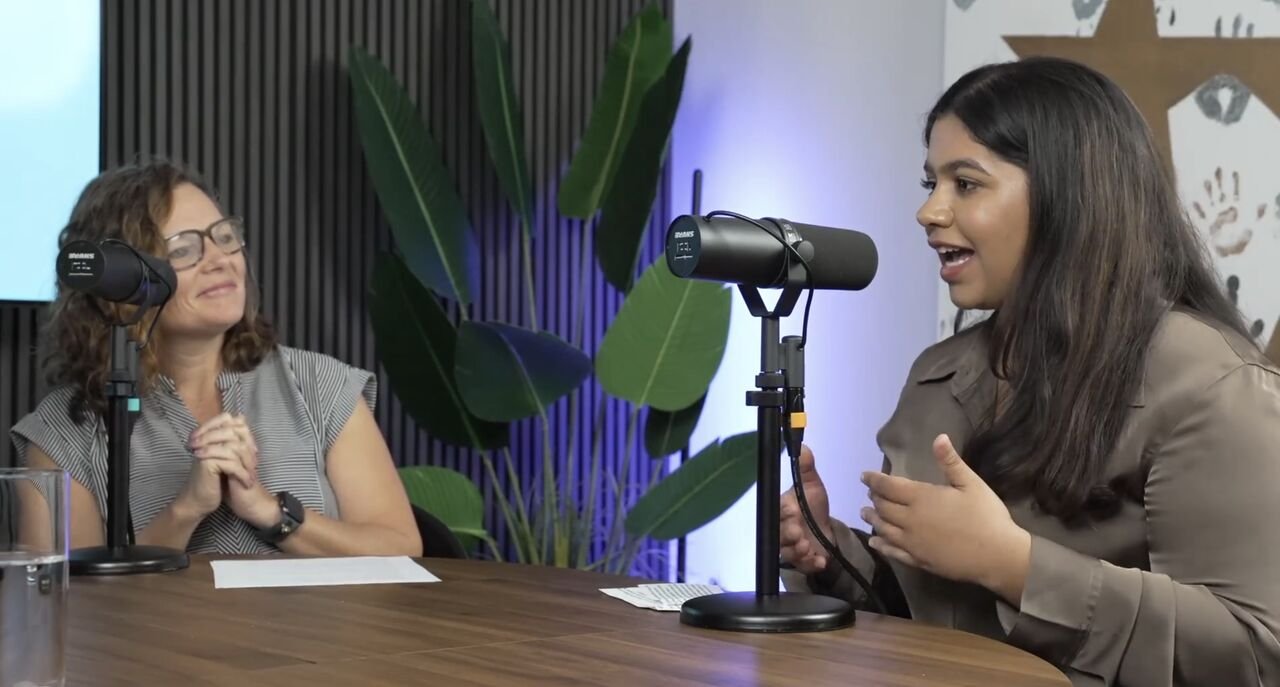
Dr. Lua Hancock (left) and Umekulsum “Umi” Fazal (right) record an episode of an interfaith podcast.
BY ARNOLD SHAKIROV, Phoenix Editor-in-Chief, Lead Designer UCF FIEA / Interactive entertainment, technical art (MS)
Arnold: Tell us a little about yourself and what made interfaith work personally meaningful to you.
Umi: The funny thing is, interfaith work wasn’t personally meaningful to me for a very long time—not because I wasn’t engaged in it but because I hadn’t noticed how much it had already been a part of me.
I grew up in an extraordinary country in East Africa called Tanzania. I grew up Muslim, and I like that phrasing because I don’t think I was simply born Muslim; eventually, I fell in love with Islam, even as I struggled and still struggle through it. Back then, my involvement in my community was fairly small, but it came through things that meant a lot to me, such as social-cause events organized by my community, blood drives held every Muharram, or good food during Ramadan Iftars.
At the same time, a part of my family was Hindu. So, growing up, I found myself participating in small traditions such as Raksha Bandhan with my cousins. I watched my grandmother pray with a mala, beads that reminded me of my own tasbeeh. I watched the Ramayana come to life on television. While in madrassa, I learned and acted out scriptural stories from the Quran. At the time, I didn't think of these experiences as interfaith.
Before coming to the United States and studying at Rollins College, I attended United World College, a global educational movement that brings together young people from different countries, cultures, and religions. Some of the best people I met there had worldviews and beliefs very different from my own.
Looking back, I realize that what made interfaith work meaningful to me wasn’t one particular experience but how difference was woven into my everyday life—and continues to shape my story today.
Arnold: What does meaningful interfaith work look like to you?
Umi: There are many ways to describe what meaningful interfaith work looks like, but if I were to put it simply, I would say meaningful interfaith work starts when you realize that humanity is your first religion. From that recognition grows the foundation for truly pluralistic communities—communities rooted in empathy, belonging, interconnectedness, collaboration, and peace building. It looks like creating spaces where people can honor their differences, learn from one another, build genuine relationships, and recognize their shared responsibility to one another.
Arnold: How do you create a space where someone can speak honestly without feeling responsible for representing an entire religion?
Umi: Make it explicit that individuals are speaking from their personal experience, and are not acting or viewed as a spokesperson for their whole religion. Also make it explicit that people within the same religion can have different perspectives. Give people the space to say, “I don’t know,” or, “I’m not comfortable answering that.” Make the focus about understanding and having curiosity, rather than judgment and unhealthy debate.
Arnold: What does each campus bring to the growing interfaith network?
Umi: When I think of the four campuses I have worked with most often, I see something unique that each brings to the growing interfaith network.
UCF: With 45 different faith organizations, the UCF Interfaith Council—the scale of it is jaw-dropping. There is such a wide range of faith traditions and perspectives represented, which creates so much potential for connection and collaboration.
Rollins College: Shout out to your amazing Religious and Spiritual Life team, which brings in amazing interfaith scholars and chaplain Fellows; the interfaith programming is so intentional. I’ve had some of my best exchanges of interfaith dialogue in the Interfaith Room in Knowles Chapel.
Valencia College: Valencia has such a cool focus on religious inclusion and accommodation. Because it serves such a broad range of students and communities, there is an incredible opportunity to make interfaith work something that feels relevant and accessible to everyday students—not just something that happens within a traditional campus religious-life setting.
Stetson University: Stetson has a strong history of interfaith dialogue and cooperation, including interfaith initiatives through its diversity infrastructure, religious and spiritual-life programming, and an interfaith calendar designed to encourage dialogue and awareness of religious holidays.
Arnold: Why can working beside someone through service create a different connection than conversation alone?
Umi: Service turns shared values into shared experiences. The deepest connections aren’t always formed by talking about our differences but by showing up for something greater than ourselves.
Tell us about a difficult or surprising moment in this work. How did you respond?
Interfaith work is not all kumbaya. It can be messy, uncomfortable, and sometimes challenging. You are bringing people together who may have very different beliefs, assumptions, experiences, and perspectives—even within the same faith tradition—and meaningful dialogue doesn’t mean everyone is going to agree.
Part of interfaith work is not about abandoning your own beliefs or worldviews. When I don’t agree, I have learned how to listen with resilience. To me, that means staying open through discomfort, choosing curiosity over defensiveness, and allowing disagreements to become opportunities for understanding.
Arnold: How do you welcome religious students, nonreligious students, and people who are still questioning their beliefs?
Umi: By making it explicit that everyone has a seat at the table. Interfaith spaces should invite people to come as they are and belong without having to explain or defend their identity. A religious student could bring lived faith experiences, a nonreligious student could offer a different perspective, and students questioning their beliefs could bring curiosity and openness. Whatever the case, doesn’t that make for a whole lot more interesting table?
What change would make you feel that this interfaith initiative succeeded?
According to the 2020 Interfaith Diversity Experiences and Attitudes Longitudinal Survey (IDEALS), published by Interfaith America and tracking students across four years at 122 colleges and universities, 93 percent of college students reported having at least one interfaith friendship, yet 59 percent had never disagreed with those friends about religion. While 96 percent reported goodwill toward other traditions, only 32 percent felt they had developed the skills to engage religious differences.
For me, success would mean helping young people move from coexistence to genuine connection. I would want young people to not simply live alongside difference but understand and learn from it—because that is what it means to create a truly pluralistic space.
Arnold: What advice would you give someone afraid of saying the wrong thing?
Umi: I’d say, “What’s the worst that can happen? You might say the wrong thing. And if you do, you have an opportunity to listen, learn, apologize if necessary, and do better.”
Interfaith work requires us to be willing to be imperfect. If we are so afraid of saying the wrong thing that we never ask questions or engage with one another, we lose the opportunity for genuine connection and understanding. Curiosity, humility, and a willingness to learn are more important than getting everything right the first time.
Arnold: What quote, belief, or principle guides your interfaith work?
Umi: Ubuntu, the belief that “I am because we are.” That principle is at the heart of how I approach interfaith work.